Showing posts with label China. Show all posts

Friday, September 17, 2010

China - Jiuxigou Bridge 九溪溝橋


Stamp Issue : 1978-11-01 

Situated in Jiuxigou in Fengdu County, Sichuan Province, Jiuxigou Bridge is a highway bridge. Straddling 116 meters on a single span and with a width of 7.5 meters, the bridge was completed in 1972 and was the world's largest single-arch stone bridge at the time. The main arch is variable-section catenary, with the vault 1.6 meters thick, bottom arch 2.25 meters thick amd arch vector degrees 1/8. The masonry construction was done ring by ring in the scaffolding.


九溪溝橋位於四川省豐都縣九溪溝的公路橋,跨徑為116公尺,建成時是世界上跨徑最大的石拱橋,於1972年建成。橋寬7.5公尺,主拱圈為變截面懸鏈線,拱頂厚1.6公尺,拱腳厚2.25公尺,拱矢度1/8。施工方法是在腳手架上分圈砌築。

Friday, September 10, 2010

China - Chengyang Bridge 程陽橋


Stamp Issue : 1962-05-15 

Situated in Sanjiang County in Liuzhou in Guangxi Province, Chengyang Bridge (aka Chengyang Wind-Rain Bridge) is a famous bridge which belongs to the Dong Minority Autonomous Region. With particular covered corridors and pavilions, the bridge, aka Wind-Rain Bridge is one of a kind in the local Dong Minority Region. Completed in 1916, the bridge is also known as Yongji Bridge and Panlong Bridge.
Crossing over LinXi River, Chengyang Bridge is a perfect combination of painting, bridge, corridor, veranda and Chinese pavilion. At two ends of the bridge are platforms, the bridge has 3 piers, 4 spans, 19 verandas, and 5 pavilions with 3 floors. The piers are made of stone. The upper main structures are mainly wood, and the roofs are covered with tiles. On both sides of the bridge are wooden handrails.
About 10 meters above the river, the bridge is 64.4 meters long in total and the corridor is 3.4 meters wide.


程陽橋又稱程陽風雨橋是位於中國廣西省柳州三江縣的一座著名的橋梁,屬於少數民族侗族自治區。這是一個特殊的廊橋和風雨橋, 是當地少數民族侗族地區特殊的橋型之一。它建於1916年,又名永濟橋或盤龍橋。
横跨林溪河,這座橋是集繪畫,橋梁,遊廊,樓臺和中國亭閣的完美結合。橋的兩端是平臺,3個橋墩,4跨度,19個遊廊和五個亭閣,3層樓板。橋墩是石質,上面的主結構為木製,屋頂覆蓋瓦片,橋的兩側有木制扶手。
橋梁長64.4公尺,它的遊廊寬3.4公尺,離河面淨高約10公尺。

Tuesday, September 7, 2010

China - Lugou Bridge 盧溝橋


Stamp Issue : 1985-09-03  


Stamp Issue : 2003-03-20 

Lugou Bridge, also known as Yongding Bridge, is located about 15 km southwest of Fengtai District of Beijing crossing the Yongding River. The bridge 266.5 meters in length, 7.5-9.3 meters in width, with 10 piers and 11 arches, is the largest ancient multi-segmental arch bridge. As Marco Polo detailed account of the Lugou Bridge in the book "Travels of Marco Polo", the bridge is also known as the Marco Polo Bridge in Europe.
Lugou Bridge was built in 1189, the 20th year of Dading in Jin Dynasty and completed in 1192, the 3rd year of Mingchang in Jin Dynasty. It was restored in 1698, the 37th year of Kangxi in Qing Dynasty. On each side are stone fences supported by 140 carved marble balusters. On top of the balusters are carved stone lions of distinct styles.
Known as "July 7 Marco Polo Bridge Incident", the incident took place on July 7, 1937 on the bridge It marked the beginning of the War of Resistance against the Imperial Japanese Army that lasted eight years.


盧溝橋也被稱為永定橋,位於北京市西南約15公里處豐台區永定河上。盧溝橋全長266.5公尺,寬7.5-9.3公尺,有橋墩十座,共11個橋孔,是中國最大的古代多涵孔圓弧拱橋。由於馬可孛羅在《馬可孛羅遊記》對盧溝橋有詳細的記述,盧溝橋在歐洲稱為馬可孛羅橋。
盧溝橋始建於1189年(金大定二十九年),並於 1192年(明昌三年)完成,後來在1698年 (康熙三十七年) 重建。兩側石雕護欄各有140條望柱,柱頭上均雕有石獅,形態各異。
1937年7月7日在盧溝橋發生的「七七盧溝橋事變」,成為中國展開全國對日八年抗戰的起點。

Sunday, August 8, 2010

China - Wuhu Yangtze River Bridge 蕪湖長江大橋


Stamp Issue : 2001-09-20 

Situated in Wuhu of the Anhui province, Wuhu Yangtze River Bridge is 10,616 meters long in total and is the longest highroad and railway steel truss cable-stayed amphibious bridge. With the main bridge 2,193 meters long over the river and the main span of 312 meters, it is the longest span highroad and railway amphibious bridges in China, as of today (2010).
Started in March 1997, the bridge was completed and open on September 30, 2000. The upper deck carries a fourlanes highway and is 18 meters wide, with a walkway 1.5 meters wide on each side. On the lower deck is the double track grade I (one) standard railway, with annual projected capacity over 20 million tons of passenger and cargo.


蕪湖長江大橋位於長江下游安徽省蕪湖市,全長10,616公尺,是目前中國最長的公路、鐵路兩用鋼桁梁斜拉橋。大橋跨江主橋長2,193公尺,主跨312公尺,是中國迄今為止(2010年)公路、鐵路兩用橋中跨度最大的橋梁。於1997年3月正式動工,2000年9月30日建成開通。公路在上層為4車道,寬18公尺,兩側人行道各寬1.5公尺,雙線鐵路在下層,遠期年客貨運量超過20百萬噸的鐵路,屬一(I)級鐵路建設標準。

Friday, July 23, 2010

China - Guangji Bridge 廣濟橋


Stamp Issue : 2009-11-16 

Guangji Bridge (aka Xiangzi Bridge) is a pontoon bridge situated in the east of Chaozhou in Guangdong Province. Crossing the Han River, the bridge is renowned as one of the four most famous ancient bridges in China with the other three being the Zhaozhou Bridge, Luoyang Bridge and Lugou Bridge.
Built in 1170 during the Southern Song Dynasty, originally a wooden pontoon bridge, the stone bridge took 57 years to complete, was 515 meters long and known as Jizhou Bridge. The two beamed sections were supported by 18 piers. Due to turbulent current, a bridge could not be built in the middle section that was about 100 meters wide. Small ferryboats were used to transport between the two beamed sections instead.
Renovated in 1435 (the 10th year of Xuande Empeor of the Ming Dynasty), the bridge was extended by erecting five more piers and 12 pavilions. It was renamed to Guangji Bridge. During the reign of Zhengde Emperor (1505–1521), another pier was erected which gave a total of 24 piers, all made in granite. The two beamed sections were connected by chaining 18 shuttle boats to form a pontoon which served as a gate that could be open and close. The boats could be disconnected to allow large boats and rafts passage, and then reconnected to return to their original position. This was the first switchable stone bridge in China and in the world, an innovation that set a precedent in bridge-building history.
Guangji Bridge was renovated many times since. In 2003, the bridge was fully restored to its original appearance and completed in June 2007.


廣濟橋又稱湘子橋,位於廣東省潮州市之東,為中國第一座啟閉式浮橋,橫跨韓江,與趙州橋、洛陽橋、蘆溝橋並稱「中國四大古橋」。
始建於公元1170年(南宋乾道六年),初為浮橋,由浮船連結而成,歷時57年建成,當時稱濟州橋,全長515公尺,分東西兩段18墩,中間一段寬約百公尺。因水流湍急,未能架橋,只用小船擺渡。
公元1435年 (明宣德十年) 重修,並增建五墩,橋上修築樓閣12座, 稱廣濟橋;正德年間,又增建一墩,總共24墩。橋墩用花崗石塊砌成。中段用18艘梭船聯成浮橋,能開能合,當大船、木排通過時,可以將浮橋中的浮船解開,讓船隻、木排通過。然後再將浮船歸回原處。這是中國、也是世界上最早的一座開關活動式大石橋。為橋建築界歷史創下先河。
後多次修建。廣濟橋2003年全面重修,2007年6月竣工。

Wednesday, July 21, 2010

China - Hangzhou Bay Bridge 杭州灣跨海大橋


Stamp Issue : 2009-06-18 

Hangzhou Bay Bridge is an S-shaped cable-stayed bridge. Starting in Jiaxing to the north, the bridge ends at Ningbo's Cixi County in the south. It shortens the ground transportation distance from Ningbo to Shanghai by 120 km. Construction was started in 2003 and completed in 2007. The bridge was open to the public on May 1, 2008. It helps relieve the traffic congestion for Shanghai-Hangzhou-Ningbo Expressway significantly.
The bridge consists of nine sections. It is 33 meters wide with six lanes, three in each direction. The total length is 36 km which makes it the longest sea-crossing bridge in the world and is expected to last at least 100 years.
There are two navigable bridges. The north navigable bridge is a cable-stayed bridge with twin diamond-shaped towers, double cable and steel box-girders. The main span of the north approach is 448 meters. The south navigable bridge is a cable-stayed bridge with an A-shaped single tower, double-cable and steel box-girders. The main span is 318 meters.
Situated 1.4 km away from the south shore is a 12,000 square meters offshore platform used for rescue services. It is also a tourist leisure area.


杭州灣跨海大橋是一座橫跨中國杭州灣海域的跨海大橋,它北起浙江省嘉興市海鹽鄭家埭,南至寧波市慈溪水路灣。橋於2003年施工,2007年竣工,2008年5月1日正式啟用。通車後寧波至上海陸路距離縮短120餘公里,大大減輕滬杭甬高速公路交通堵塞。
橋分九段,橋寬33公尺,橋面為雙向六車道。全長36公里,是世界上最長的跨海大橋。設計使用壽命100年以上。
大橋設兩個通航孔。北通航孔橋為主跨448公尺鑽石型的雙塔雙索面鋼箱梁斜拉橋。南通航孔橋為A字型單塔單索面鋼箱梁斜拉橋,主跨318公尺。
在離南岸約14公里處,設計有一個面積達1.2萬平方公尺的交通服務救援海上平台,同時也是一個旅遊休閒觀光平台。

Monday, June 28, 2010

China - Rainbow Wind and Rain Bridge 虹橋風雨樓


Stamp Issue : 2009-06-23 

The Rainbow Wind and Rain Bridge (Hongqiao Fengyulou) spans the Tuo River of the Phoenix County (Fenghuang County) in Hunan Province. Originally named the Crouching Rainbow bridge, erected in 1670 (the 9th year of the reign of Qing Emperor Kangxi), the stone arch bridge was built with the local red stone. Restored in 1914, it is renamed to Rainbow Bridge (Hongqiao).
With two piers and three arches in boat-shape, not only beautiful, the piers reduce the river flow momentum. Along each side of the original bridge, built are the 12 wooden houses as if they are hanging over the bridge (Diaojiaolou Mubanfang) are used for restaurants and retail shops. The pedestrian promenade in the center is two meter wide. The roof added on top of the promenade keeps the wind and rain out. Hence, the bridge is also called the Wind and Rain Bridge.
In 1955, with the structures removed, the bridge was turned into a road bridge. Starting in 1999, it took a year to reconstruct the houses and restore the bridge to its original look. Both sides of the bridges are for shops and retail use again.


虹橋風雨樓跨越湖南省鳳凰縣的沱江,原名臥虹橋,建於1670年(清康熙九年),完全用當地紅條石砌成的石拱橋。1914年重修,改名虹橋。
橋有2墩3孔,橋墩呈船形,不僅美觀大方,且能減輕和分解流水衝力。原橋面兩側各建有12間吊腳樓木板房,開設飲食、百貨店鋪,中間為2公尺寬人行長廊,廊上方建有屋頂,行走廊中,可避風雨,故又稱風雨樓。
1955年曾將橋上建築物拆除,修成公路橋。1999年起歷時一年,修復了虹橋風雨樓,橋梁兩邊仍作為店鋪。

Wednesday, June 23, 2010

China - Jade Belt Bridge 玉帶橋


Stamp Issue : 2008-05-10 

Jade Belt Bridge (Yudai Qiao, aka Camel Back Bridge) is one of the six famous bridges in the Summer Palace in Beijing. Situated on the West Dike (Xidi) of Kunming Lake, the bridge is so highly arched like a camel's back that the single arch spans 11.38 meters and is about 7.5 meters high. During the reign of the Qianlong Emperor of Qing Dynasty (1736-1795), Jade Belt Bridge was built in the years 1751 to 1764.
The bridge is built with marble and other white stone. The pointed arch with ornate marble-carved balustrades and the contour lines from two sides of the bridge are woven extraordinary elegantly and resembles a jade belt. Under the bridge is spring water from Jade Spring Hills (Yuquan Shan) to inlet of the Kunming Lake. A passage to Jade Spring Hills, the clearance of the arch allows the tall dragon barges to sail under the bridge easily.


玉帶橋,舊名俗称駝峰橋,是北京頤和園裏著名六橋之一,位於園內昆明湖西堤上。該橋單孔高如駝峰,淨跨11.38公尺,高約7.5公尺,建於清乾隆(西元1736-1795年)年間之西元1751-1764年。
該橋全部用玉石琢成,橋面是雙反向曲線,組成波形線橋型,配有精製白石欄杆,顯得格外優雅。蛋尖形橋拱,特別高聳,好似玉帶。橋下原為玉泉山泉水注入昆明湖的入水口,也是乘船至玉泉山的通道,高桿龍駁船也能從橋下通過。

Sunday, May 9, 2010

China - Seventeen-Arch Bridge 十七孔橋


Stamp Issue : 2008-05-10 

Seventeen-Arch Bridge (Shiqikong Qiao) is a continuous stone arch bridge. It is one of the famous scenic spots in Beijing's Summer Palace (Yiheyuan). With the deck 6.56 meters wide on the top, 4.6 meters wide on the bottom and 7 meters in height, Seventeen-Arch Bridge is named for its 17 arches and looks magnificent.
Connecting the Kuoru Pavilion (Octagonal Pavilion, Grand Pavilion) situated on the east bank of Kunming Lake in the east and Nanhu Island (South Lake Island) in the west, Seventeen-Arch Bridge is 150 meters long and 8 meters wide. It is ranked the longest and the largest amongst ancient Chinese gardens.
The stones are exquisitely carved on the bridge. There are 544 stones lions in different poses carved on the stone balustrades. At both ends of the bridge, there are vividly craved strange stone animals. Sitting on east side of the bridge is a Bronze Ox guarding the river to prevent flooding.


十七孔橋是是一座連拱石橋,北京頤和園中著名的景點之一。橋面下寬14.6公尺,橋面上寬6.56公尺,高7公尺。整座橋給人以一種雄偉高大之感。這座橋共有17個橋洞,所以叫十七孔橋。
它東連廓如亭,西接南湖島,長150公尺,寬8公尺,堪稱中國園林中最大的橋梁。
橋上石雕極其精美,每個橋欄的望柱上都雕有神態各異的獅子,大小共計544隻,橋頭還有石雕異獸,十分生動。橋的東邊有一尊鎮水銅牛。

Saturday, September 5, 2009

China - Zhaozhou Bridge


Stamp Issue : 1962-05-15 

Zhaozhou Bridge also known as Anchi Bridge is the world's oldest open-spandrel stone segmental arch bridge cross the Jiao River, about 50 m long with a central span of 37.37 m. It stands 7.3 m tall and has a width of 9 m. Credited to the design of a craftsman named Li Chun, the bridge was constructed in the years 595-605 during the Sui Dynasty (581–618). Located in the southern part of Hebei Province, it is the oldest standing bridge in China. In the next 1400 years, the bridge survived at least eight wars, ten major floods and numerous earthquakes, the nearest of which being the 7.2 degree Xingtai Earthquake in 1966. Yet, the support structure remains intact and the bridge is still in use. Only the ornamental railings have been replaced every few hundred years.


Sunday, December 28, 2008

China - Broken Bridge in the West Lake


Stamp Issue : 1989-11-25 

Broken Bridge in the West Lake, is a famous fresh water lake located in the historic center of Hangzhou, in Zhejiang province of eastern China.
It is a recovery bridge with a single arch. The most romantic scene of the ten must-see around the West Lake is the Melting Snow on the Broken Bridge. The stone-arched Broken Bridge is where the characters of a famous Chinese folktale, Xu Xian and a beautiful girl, who is actually a white snake, first met and fell in love with each other. After a snowfall, when the snow on the more exposed side has melted, with the shaded side remaining white, it looks as if a long white belt has been ripped apart on the bridge, thus earning the name "Melting Snow on the Broken Bridge".


Sunday, December 14, 2008

China - Jiujiang Yangtze River Bridge


Stamp Issue : 1996-09-01 

Jiujiang Yangtze River Bridge, at a length of 7,679 metres, is the longest across the Yangtze River. It is a combined road and rail bridge which crosses the Yangtze River. It links the Xunyang District of Jiujiang from the south and Xiaochi Town (Huangmei County, Hubei Province) from the north.
Jiujiang Yangtze Bridge was begun to be built in December, 1973. It is the eighthly built bridge across Yangtze River and the longest two-layer bridge in China. With 10 piers in the river and 11 girders, the spans vary from 126 to 216 meters.
Jiujiang Yangtze Bridge has now become an intersection of Jingjiu Railway since it was built, which improves the communications between the north and south, the east and west. It has played an important role in the interchanges of economy, cultures and tourism in the neighboring provinces. Therefore, Jiujiang has been put in a favorable geographical position.


Friday, December 5, 2008

China -Wumen Bridge


Stamp Issue : 1996-10-09 

Wumen Bridge was built in 1084 and is the highest ancient bridge in Suzhou now. The bridge is 11 meters high and 66.3 meters long. it was rebuilt into a single arched stone bridge. Its construction dates back to the Northern Song Dynasty but was rebuilt in the reign of Emperor Tongzhi of the Qing Dynasty. Likened to a rainbow, it spans the Grand Canal in a single arch.


Wednesday, December 3, 2008

China - Sing-horng Bridge


Stamp Issue : 1978-11-01 

Sing-horng Bridge built in 1973, China's first hyperbolic arch bridge (the main arch ring in the vertical and horizontal direction are two arched steel-reinforced concrete arch bridge), thin, lightweight structure . The main cross-roads single-hole arch bridge 80 meters, 7 meters broad Bridge, the main arch ring spacing 5.2 m. The bridge 96 m in length, cross the Sunan Canal, in Wuxi, in Jiangsu Province.
The bridge in Dec. 1993 reconstruction, Dec. 31, 1994 completion of the opening to use.


Saturday, November 29, 2008

China - Precious Belt Bridge


Stamp Issue : 1962-05-15 

Precious Belt Bridge is a Chinese stone arch bridge located near the city of Suzhou, Jiangsu Province, China. The Precious Belt Bridge is located at the intersection of the Grand Canal and Dantai Lake, about 2.5 kilometer south east of Suzhou. The first construction of the bridge dates back to the year 816 AD, during the mid Tang Dynasty. The bridge's span is 317 m long and has a width of 4.1 m, with a total of 53 arches in its span. The three central arches are enlarged to allow for the passage of - by historical standards - larger river vessels without masts. The average span of each arch is 4.6 m.


Friday, November 21, 2008

China - Jiangyin Bridge


Stamp Issue : 2000-03-26 

Jiangyin Bridge is the most seaward suspension bridge to cross the Yangtze River of China. The concrete towers are 190 metres tall, roughly equivalent in height to a 60 story building. It connects the cities of Jiangyin and Jingjiang. The main span of the bridge is 1,385 metres long, making it the sixth-longest span suspension bridge in the world and the largest in China at the time of its completion in 1999. The bridge opened on September 28, 1999.


Wednesday, November 12, 2008

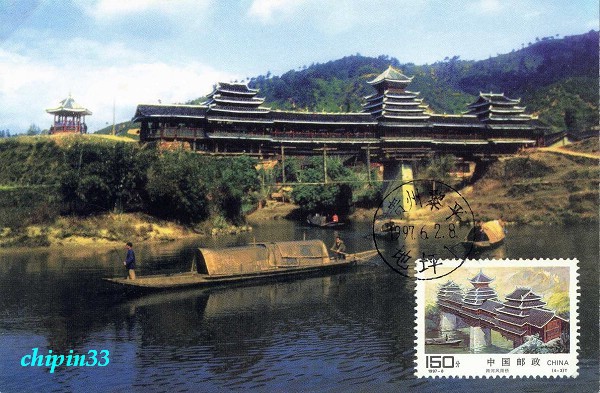
China - Wind-Rain Bridge


Stamp Issue : 1997-06-02 

A remarkable Wind-Rain Bridge cross a river, near the county of Liping. Wind-and-rain Bridge is a wooden covered corridor bridge, with pavilions and benches. In Dong areas there are lots of wind-and-rain bridges: over 50 just in Liping County, and more are distributed in the Sanjiang area. The most representative one is Chengyang Bridge, in Sanjiang, Guangxi Province. It was built in 1916: 76 meters long, 10.6 meters high and 3.4 meters wide; 5 piers and 4 openings; like a huge dragon across the Chengyang River; one of the four most famous bridges in China, and an important national cultural relic. Eight fir logs are laid closely on the piers in two layers, above which are five pavilions of different styles of roofs, built together to form the covered corridor bridge floor. The three pavilions in the middle are in a four-layer pagoda style, while the other two are in a five-layer long-ridge style. The five pavilions stand in a row, in a magnificent manner. On eaves of the corridor and the pavilions, lively and colorful images such as mountains, rivers, lakes, flowers, birds, beasts and fish, are painted. The interesting thing is the leverage used in the pavilion eaves, with beams sticking out widely; thus the eaves curl upwards, like a white crane spreading its wings wide, ready to fly up to the sky.


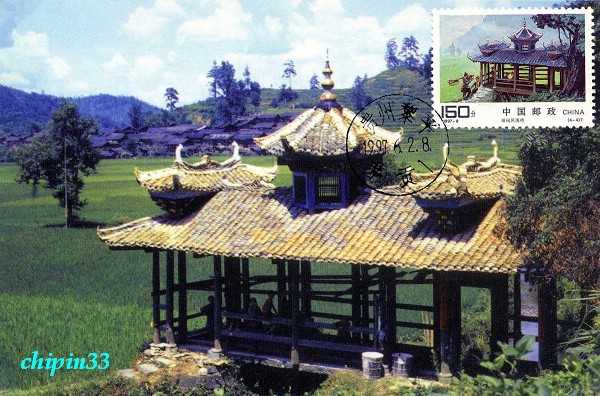
China - Wind-Rain Bridge


Stamp Issue : 1997-06-02 

A small Wind-rain Bridge cross a small stream in the Farmland. Wind-and-rain Bridge is a wooden covered corridor bridge, with pavilions and benches. It's a typical building in the area of Dong minority in China. People can rest on the bridge sitting or lying. Since the bridge shields people from wind, rain and sunshine, it is called the wind-and-rain Bridge, or sometimes "the flower bridge". For large-sized wind-and-rain bridges, the piers are made of big bluestone, upon which, big logs are spliced together by tenons, in a reversed pyramid, as the girder of the bridge. Upon these logs is the covering of the girder. In this way the openings have got a larger width. On the piers are pavilions, to add to the beauty of the bridge and the weight on both ends of the beams, and to increase the stability of the bridge body. Pavilions mostly have five layers of eaves, with a quadrangular or hexagonal roof, which is a spire or a long ridge; both practical and of artistic value.


Saturday, September 6, 2008

China - Anlan Bridge


Stamp Issue : 1962-05-15

Anlan Bridge is suspension bridge with Rope made from bamboo, crosses the Minjiang River bestriding the water of the Inner Canal and Outer Canal to connect Erwang Temple with the Dujiangyan Irrigation System.
Anlan Bridge is 261 meters long. It is supported by wooden pegs and stone piers. The bridge crosses the river by using bamboo ropes. The bridge is secured by bamboo ropes on two sides, in length of which are about 500 meters each. When the bridge was restored, steel ropes were used instead of bamboo ropes. The wooden pegs which supported the cable were changed to ferroconcrete pegs, and the length of the bridge become 240 meters.


Friday, September 5, 2008

China - Nanjing Yangtze River Bridge


Stamp Issue : 1968-12-29  


Stamp Issue : 1979-10-30 

Nanjing Yangtze River Bridge is the first bridge across the Yangtze River in Nanjing, China. It was completed in 1968 during the cultural revolution, and is the first double-decker, double-track highway and railway bridge designed and only constructed by the Chinese without outside engineering assistance. The influence of the era is evident in the socialist-inspired statues on either side of the bridge. The bridge deck provides a good view of the river. It is possible to walk from one side of the bridge to the other.
The bridge is 6,772 meters long and has a span of 160 m , it can take up to 15 minutes to cross during regular traffic periods.