skip to main |
skip to sidebar
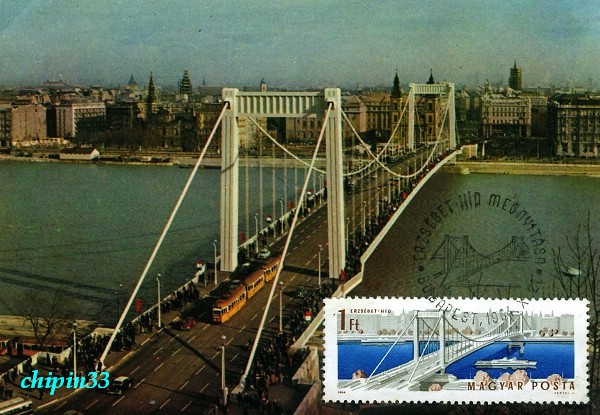
Stamp Issue : 1964-11-21

Stamp Issue : 1965-05-10
Elisabeth Bridge (Erzsébet Bridge) is the second newest bridge and one of the most elegant ones of Budapest, Hungary, connecting Buda and Pest across the River Danube. It is situated at the narrowest part of the Danube, the bridge spanning only 290 m. It is named after Queen Elisabeth, a popular queen and empress of Austria-Hungary, who was assassinated in 1898. Today, her large bronze statue sits by the bridge's Buda side connection in the middle of a small garden.
伊麗莎白大橋。
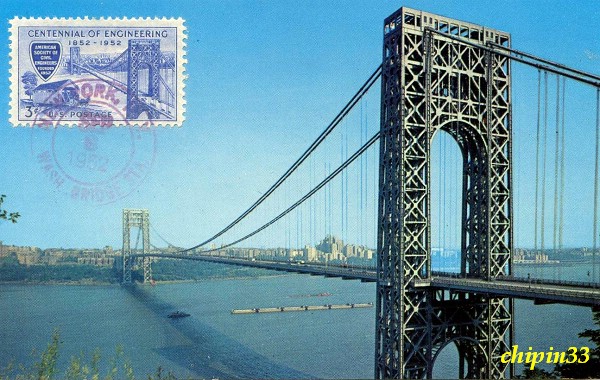
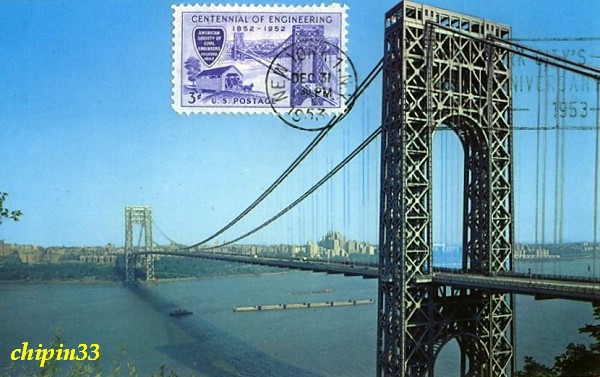
Stamp Issue : 1952-09-08
George Washington Bridge is a suspension bridge spanning the Hudson River, connecting the Washington Heights neighborhood in the borough of Manhattan in New York City to Fort Lee in New Jersey by means of Interstate 95, U.S. Route 1/9. U.S. Route 46, which is entirely in New Jersey, ends halfway across the bridge at the state border. The GWB is considered one of the world's busiest bridges in terms of vehicle traffic. The bridge carried 107,912,000 vehicles last year, down slightly from the 2006 volume of 108,529,830 vehicles, according to the Port Authority of New York and New Jersey — the bi-state government agency that owns and operates several area bridges, tunnels, and airports.
The GW span is the fourth longest suspension bridge in the United States. It contains two levels — an upper level with four lanes in each direction and a lower level with three lanes in each direction, for a total of 14 lanes of travel. Additionally, the bridge houses a path on each side of the bridge's upper level for pedestrian traffic. The speed limit on the bridge is 45 mph (70 km/h), though heavy traffic is common and frequently makes it difficult to reach such speeds, especially during the morning rush hour into New York City.
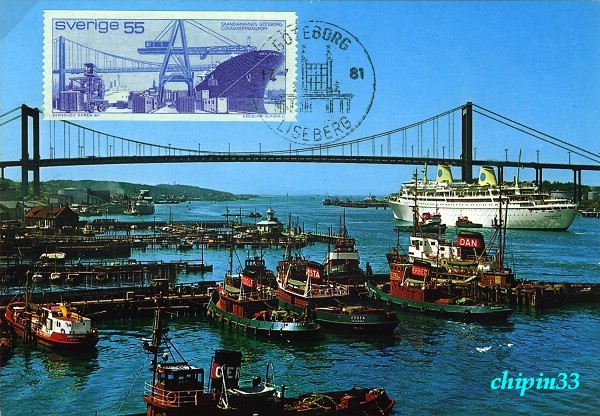
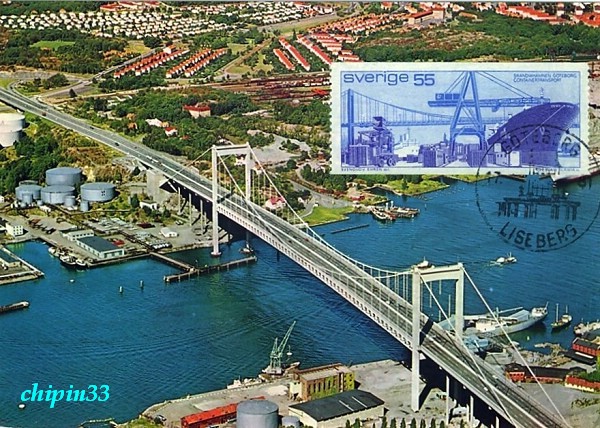
Stamp Issue : 1971-
Älvsborg Bridge is a suspension bridge over Göta älv in Gothenburg, Sweden, which connects the north and the south part of the city. It was built in 1966 and designed by Sven Olof Asplund. The total length of the bridge is 933 meters and distance between the towers ("main span") is 417 meters, while the clearance below the bridge is 45 meters. The pylons are 107 meters tall making the bridge one of Gothenburgs most prominent landmarks.
The bridge was painted green for the 1995 World Championships in Athletics which Gothenburg hosted. Work started in 1993 and used about 36,000 litres of paint.
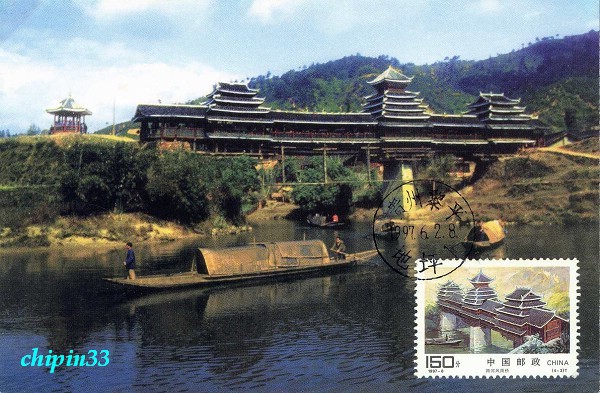
Stamp Issue : 1997-06-02
A remarkable Wind-Rain Bridge cross a river, near the county of Liping. Wind-and-rain Bridge is a wooden covered corridor bridge, with pavilions and benches. In Dong areas there are lots of wind-and-rain bridges: over 50 just in Liping County, and more are distributed in the Sanjiang area. The most representative one is Chengyang Bridge, in Sanjiang, Guangxi Province. It was built in 1916: 76 meters long, 10.6 meters high and 3.4 meters wide; 5 piers and 4 openings; like a huge dragon across the Chengyang River; one of the four most famous bridges in China, and an important national cultural relic. Eight fir logs are laid closely on the piers in two layers, above which are five pavilions of different styles of roofs, built together to form the covered corridor bridge floor. The three pavilions in the middle are in a four-layer pagoda style, while the other two are in a five-layer long-ridge style. The five pavilions stand in a row, in a magnificent manner. On eaves of the corridor and the pavilions, lively and colorful images such as mountains, rivers, lakes, flowers, birds, beasts and fish, are painted. The interesting thing is the leverage used in the pavilion eaves, with beams sticking out widely; thus the eaves curl upwards, like a white crane spreading its wings wide, ready to fly up to the sky.
Stamp Issue : 1997-06-02
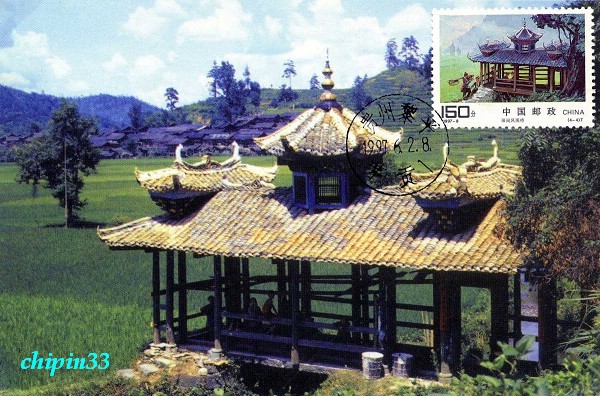
A small Wind-rain Bridge cross a small stream in the Farmland. Wind-and-rain Bridge is a wooden covered corridor bridge, with pavilions and benches. It's a typical building in the area of Dong minority in China. People can rest on the bridge sitting or lying. Since the bridge shields people from wind, rain and sunshine, it is called the wind-and-rain Bridge, or sometimes "the flower bridge". For large-sized wind-and-rain bridges, the piers are made of big bluestone, upon which, big logs are spliced together by tenons, in a reversed pyramid, as the girder of the bridge. Upon these logs is the covering of the girder. In this way the openings have got a larger width. On the piers are pavilions, to add to the beauty of the bridge and the weight on both ends of the beams, and to increase the stability of the bridge body. Pavilions mostly have five layers of eaves, with a quadrangular or hexagonal roof, which is a spire or a long ridge; both practical and of artistic value.
Stamp Issue : 1986-08-07
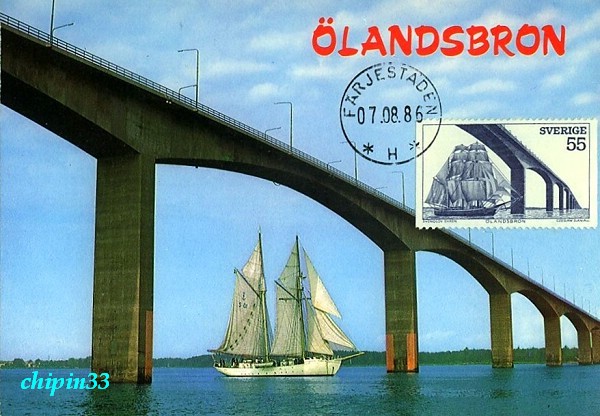
Öland Bridge (Swedish: Ölandsbron) is a road bridge connecting Kalmar on mainland Sweden to Färjestaden (Ferry Town) on the island of Öland to its east. It is 6,072 m long, supported on 156 pillars, and has a characteristic hump at its western end – created to provide a vertical clearance of 36 m for shipping.
A little to the south of the western end of the bridge a small wooden pedestrian and cycle bridge, around 150 m in length and connecting the island of Svinö to the mainland, echoes the form of the Öland bridge. This "replica" is clearly visible to anyone crossing to Öland via the main bridge.
The bridge is the longest in Sweden and one of the longest in all Europe. The Oresund Bridge linking Sweden with Denmark is longer overall, but not that part of it lying wholly within Sweden.

Stamp Issue : 1947-05-24
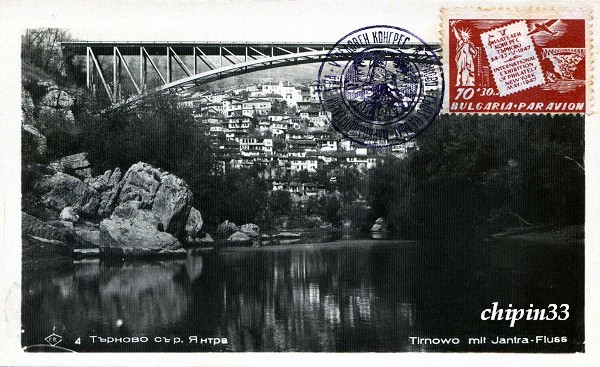
Tarnovo Bridge, cross the Yantra River, in Veliko Tirnovo. The Veliko Tŭrnovo, formerly Trnovo or Tirnovo, city(1993 pop. 69,059), N central Bulgaria, on the Yantra River. It is a commercial center and produces foodstuffs, textiles, and leather. Trnovo is the seat of an Eastern Orthodox metropolitan. The site was probably a Roman fortress. The second Bulgarian kingdom came into existence at Trnovo when Ivan I was proclaimed czar in 1186. It was the capital of Bulgaria under Ivan II, who built(1230) the Church of the Forty Martyrs. The city fell to the Turks in 1393. A Bulgarian constitution was drafted in 1879 at Trnovo, where the full independence of Bulgaria was proclaimed in 1908. In 1965 the city was renamed Veliko ( "Greater" ) Tŭrnovo.
Stamp Issue : 1936-09-21
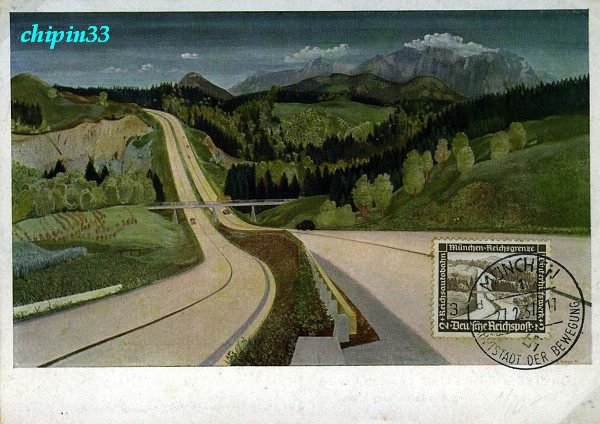
The bridge is across Frontier highway, in Munich.
(I have no other information about this bridge, and hope you can provide it, email me please, thanks!)